
Beat Up Mike Tyson, Sneak Peek at the New Zelda, and Other Revelations
Diving into the Fun Club Newsletter Vol. 4
Nintendo is Great’s paid subscribers get access to lots of cool, niche stuff, like today’s breakdown of 37-year-old Nintendo reading material.
If you’re subscribed to the free tier, and you’re considering a paid subscription, you might want to wait. I’ll be having a 40th Birthday Special in about 5 days. Not sure how much I’ll mark off subscriptions, but perhaps a nice round number, like, oh… 35 or so?
Oh wait! 40% off! Because I’m turning 40! Ah, it’s all come together now.
Whether you’re all paid up or you’re free (fallin), I’m glad you’re here. Have a glimpse behind the paywall curtain, on the house. And hey, if you haven’t subscribed at all yet, please do so right here. Cheers!
In today’s post, I’ll be discussing each page in the first half of the Nintendo Fun Club Newsletter Vol. 4, Winter 1987 issue.
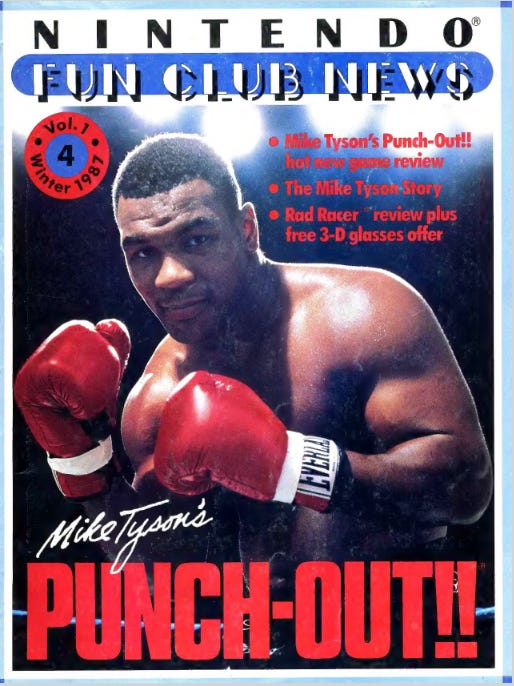
Not sure if I have any younger readers, but if I do, it’s hard to emphasize just how huge Mike Tyson was in the late 80s. People who didn’t care about boxing would tune into his bouts just to watch him jab. He was a hurricane force, both in and out of the ring. For Nintendo to sign him for a video game, even if it was just a three-year deal, was a huge get.
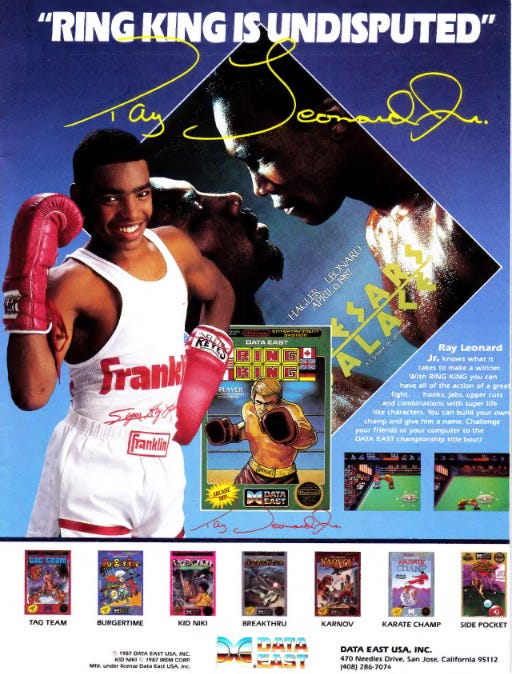
Poor Ray Leonard Jr. He certainly backed the wrong boxing game.
Hilarious that this ad is the first thing you see after the cover advertising another (considerably better) boxing title!
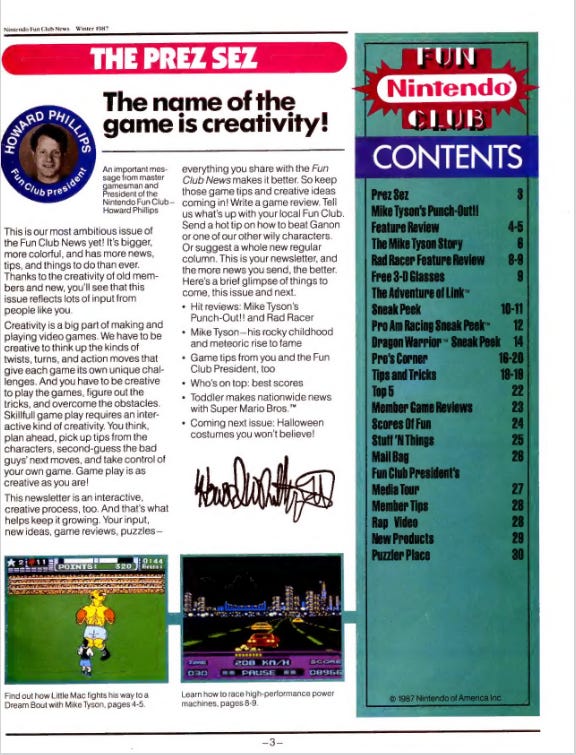
I don’t blame you for not reading Howard Philips’ entire editorial, but I appreciate him highlighting how important creativity is within both game development itself and each player’s own skills/abilities to overcome the game’s challenges. How I wish the industry at large would heed his humble words from a simpler time.
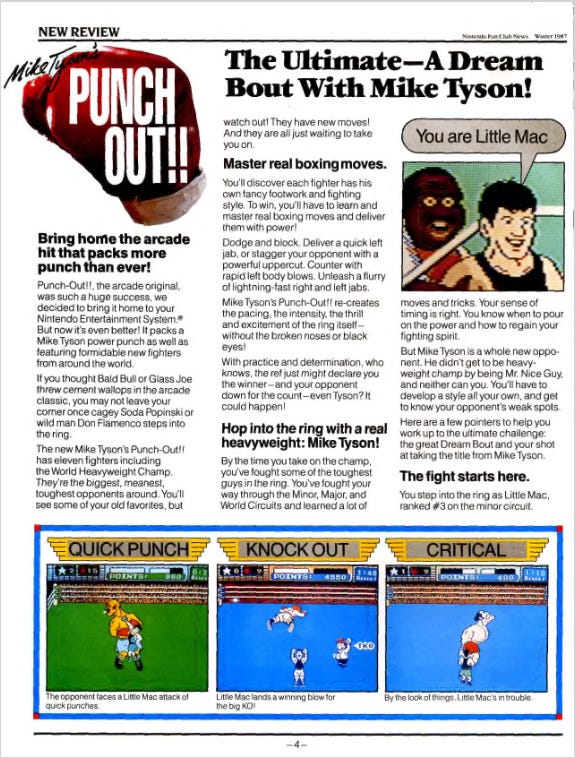
Coach’s excited bugged-out eyes never get old. Also, why is Little Mac calling you Little Mac?
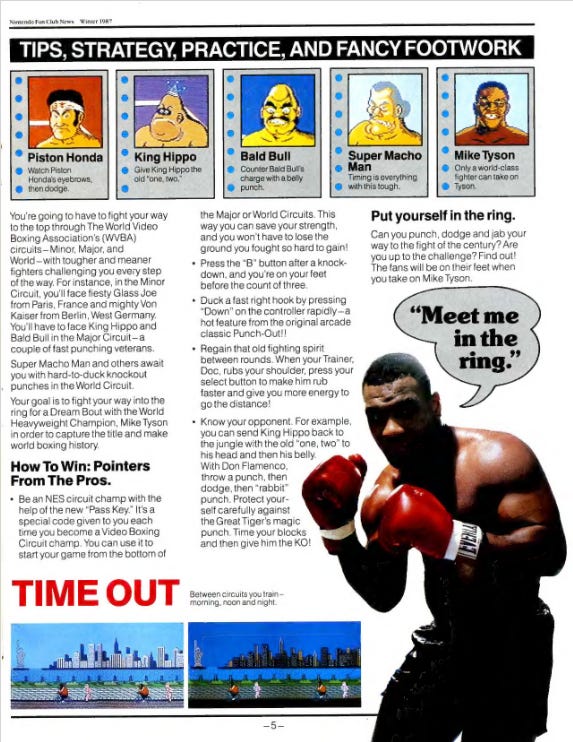
Shame that Mike Tyson’s contract with Nintendo for his likeness only lasted three years. Fighting Mr. Dream at the end of the game just isn’t the same…
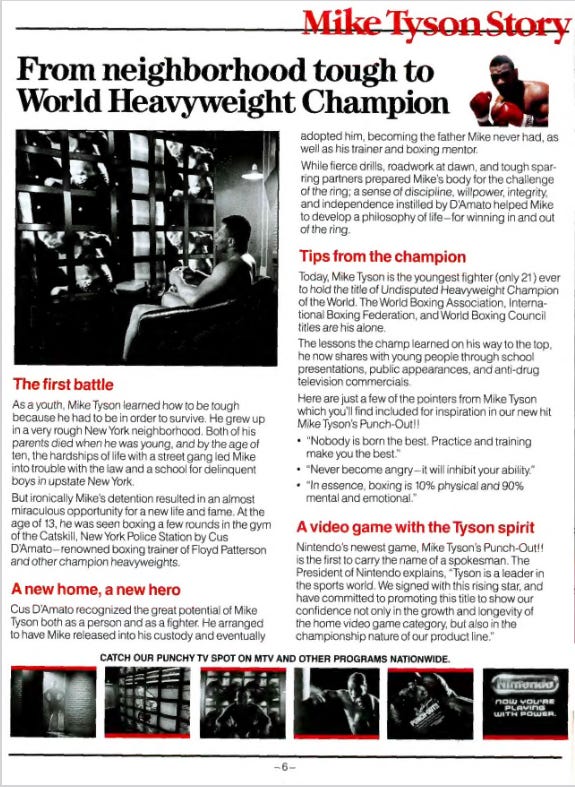
“Never become angry - it will inhibit your ability.”
Truer words never spoken, Mr. Tyson.
Also… punchy TV spot? What could that be?
I don’t care what anyone says, this is still a great ad. All those TVs! Is that really Mike Tyson playing the game? The camera hides his face until he flips around at the last minute and - gasp! - there he is, the champ, laughing at you! Only one thing to do now: buy Mike Tyson’s Punch-Out!! and wipe the smile off his face.
What title did Sunsoft hold, exactly? Wonder if that number still works…
This is less a review than a glowing writeup for a Nintendo-published game. But that’s ok, because Rad Racer really is that good.
Also, I know the 3D glasses that came with the game were trash, but I wonder if the so-called “high-quality stylized 3D racing glasses” (available to order for free on the next page) were any better.
Rad hazards or “raz-ards” as they’re also called are incredibly terrifying and exhilarating at the same time and for the same reasons.
If I had to guess, those 3D glasses still don’t work with the game, but at least they’re made of that hard plastic that cuts into the side of your head and not flimsy paper.
Wait, what? Didn’t The Legend of Zelda just come out in August of ‘87, and they’re already showing a preview of Zelda II?
Well, for awhile during the NES and early Super NES era, the US received some of Nintendo’s biggest games about a year after their Japanese release. The Legend of Zelda came out on February 21, 1986 for the Famicom Disk System in Japan. Zelda II: The Adventure of Link arrived on January 14th, 1987 in Japan, but wouldn’t find its way to American shores until December 1st, 1988, a full year after this preview.
My guess: the game was done and ready to be released in North America probably in the first half of 1988. But the original Legend of Zelda continued to sell so well, Nintendo decided to hold off releasing the sequel until the Christmas ‘88 season for maximum profits.
Crazy how much they’re showing of the game here.
Also, I wonder how huge fans of the original LoZ felt about the perspective shift in the sequel, particularly upon seeing these screenshots. Zelda II would of course become a divisive sequel, due to the shift in gameplay, but I wonder if seeds of doubt were planted with this preliminary coverage.
Pro Am Racing would later be called R.C. Pro-Am. This game would sell millions of copies and be considered a beloved classic during the NES days, but I don’t see too much appreciation for it today.
Wow! Capcom took out a full-page ad for the first Mega Man in Nintendo’s Fun Club newsletter, and the game still didn’t sell very well.
Not that ads mean a game will sell great or anything - far from it! - but Capcom clearly had faith that the game was good and worth promoting.
Perhaps if the ad featured more screenshots of the gameplay and less emphasis on the poor, broken man on the cover, hardcore NES gamers would have been more likely to pick it up.
Oh my gosh, I want eight posters from Konami for $5.95 ($16.57 in today’s money)! Those are probably worth way too much money now…
Ok yup, way too much money.
Also, Dragon Warrior wouldn’t see release until nearly two years after this newsletter’s printing in August 1989.
LJN untruths incoming…
“Enteractive video games are brand new titles specifically designed for American video wizards.”
The concept of an “Enteractive” game being different from other video games is as opaque and meaningless as “Blast Processing,” although not nearly as memorable.
Oh hey, Legend of Zelda boss tips! Nintendo brought back Gleeoks for Tears of the Kingdom, they should totally revive Aquamentus for the next Zelda game.
Man, what a tease.
C’mon, Howard, give up the goods already! How do we get into the second quest?!
Thanks so much for joining me as I look into these antiquated (and awesome) old Nintendo newsletters. We’ll finish Vol. 4 next week. Until then!


It looks they were working on a boxing theme with those first few ads but gave it up midway through the issue. With Mike Tyson in it, Punch Out really showed that Nintendo was starting to become a huge pop culture phenomenon and it was such a good game too.