
Nintendo is Great is a Substack devoted to exploring the world of Nintendo - their games, their consoles, their merchandise - in mostly chronological order, starting with the NES and continuing to the upcoming Switch 2.
Some posts are free, while some, like this one, are for paid subscribers only. However, starting today, monthly and annual subscriptions are 40% off for the next week! This offer expires April 1st, so take advantage while you can in the link below!
https://nintendoisgreat.substack.com/e58f3757
Don’t forget to sign up below. Thanks for reading!
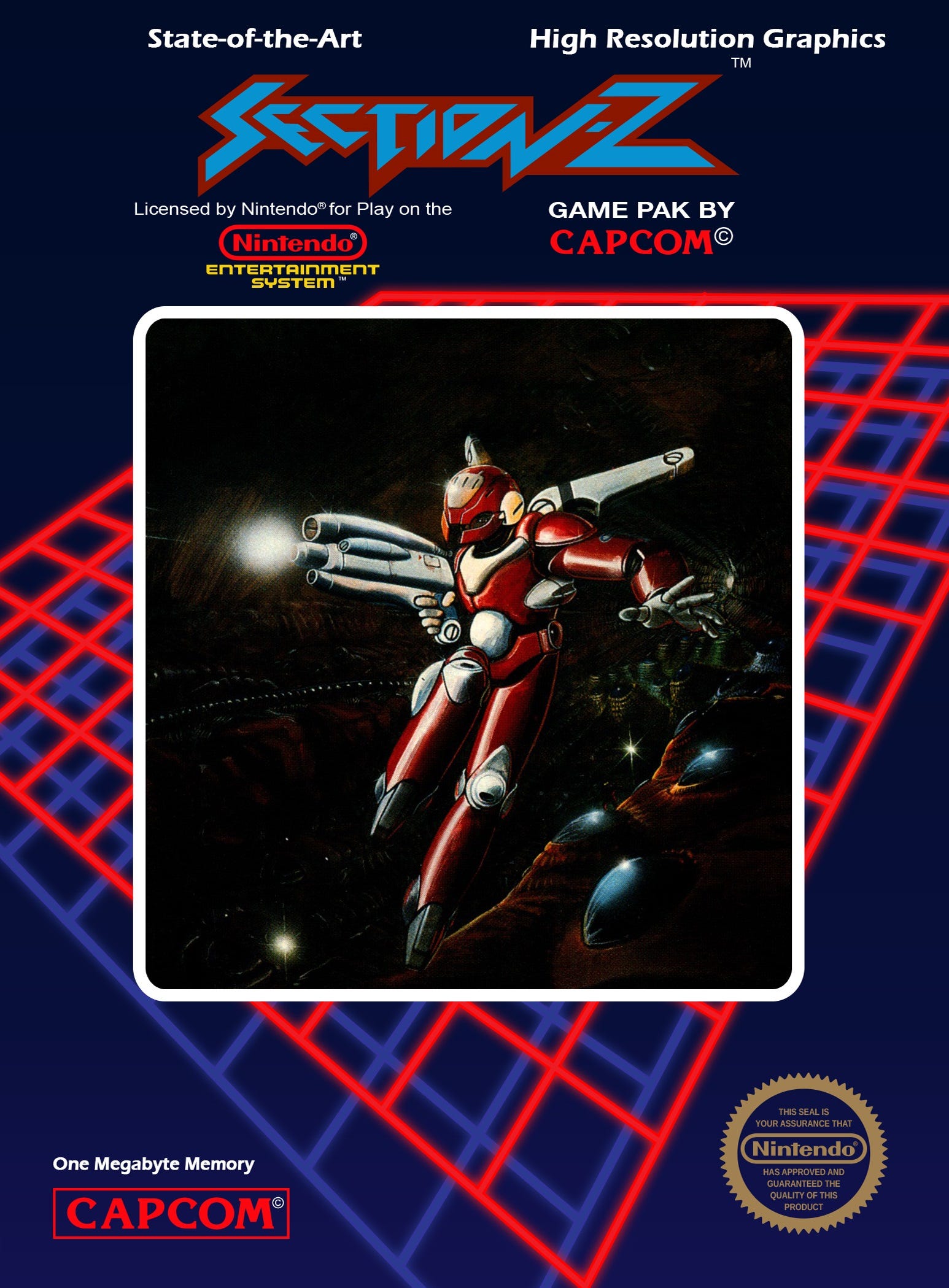
Section-Z
PUBLISHER/DEVELOPER: Capcom
RELEASE DATE: July 1987 (US), Sept. 27th, 1989 (EU)
ALSO AVAILABLE ON: Arcade, Famicom Disk System
Imagine a shoot-em-up comprised not of fully formed levels, but of half-baked, incomplete vignettes. Welcome to Section-Z, an experimental Capcom-developed game with unique ideas that feel stilted in execution.
You control Captain Commando, a space fighter working to save the galaxy, do good, all that heroic jazz. He’s called into a space station to stop the L-Brain, a destroyer of worlds, presumably. Armed only with his laser and a modicum of health, he must upgrade his weapons, find shields to prevent his death, and not go insane as he swears he’s already visited this part of the station before.
This space station isn’t any ordinary floating piece of scrap. It’s divided into sixty sections, Sections 00-59. These area are short and usually have a couple different types of enemies firing lots of harmful pellets at you. Shoot ‘em down, and before you know it, you’ll arrive at two separate pathways, up or down. Each brings you to a different section, and this is where things get tricky. Depending on the path you choose, you’ll either advance further, go backwards, or repeat a section you’ve already completed. Moving forward with the least amount of effort requires you to map a pathway to the correct sections in order to progress.
A sorta non-linear shoot-em-up is a novel concept, but the gameplay never lives up to the premise. The best shooters are tough-as-nails rollercoaster rides with their own built-in sense of rhythm. They know when to overwhelm, when to ease up, when to make the player feel like a bad ass. Section-Z has no such rhythm. Whether a section is overly easy or ridiculously hard, they always end abruptly with a pathway to another section, then another and another until you finally reach the boss. A never-ending loop of dissatisfaction.
Straight From the Arcade
*images courtesy of Pac-Rats, Launchbox Games, the Arcade Flyer Archive and Moby Games
Famicom Disk Attack!
Both the NES and the FDS versions are nearly identical, but the FDS version allows you to save your game! Also, the latter comes on a sweet, yellow disk, which is about 70% more rad than a gray cartridge, according to video game scientists.
Solomon’s Key
PUBLISHER/DEVELOPER: Tecmo
RELEASE DATE: July 30th, 1986 (JP), July 1987 (US), March 30th, 1990 (EU)
ALSO AVAILABLE ON: Arcade, Commodore 64, Amstrad CPC, Famicom Disk System, Mobile, Nintendo Switch (via Arcade Archives), PC, PlayStation 4 (via Arcade Archives), Master System, Atari ST, ZX81/Spectrum, Virtual Console (Wii, 3DS, Wii U), Nintendo Switch Online
Solomon’s Key hides its cryptic mysteries behind bricks, bells, and keys. The type of arcane knowledge mankind couldn’t handle, so it was sealed away for ages. Sealed, that is, until some rube came and unrolled scrolls he had no business opening. Now, the world’s shaking and only one person can make things right.
Dana the wizard is tasked with setting this odd world straight, maybe rescue a fairy or two along the way. He’s no Gandalf, though, full of surprises and resurrections. All Dana can do is jump, create and destroy blocks, and unleash the occasional fireball. It’d be nice if he had a more consistent attack, but hey, where’s the challenge in that?
In each of the game’s fifty rooms, Dana must retrieve the key to open the door and move to the next room. Only a few rooms in, however, and Dana’s adventure is already rock hard. Creating bricks to climb higher and re-route enemies is fun and all, but figuring out how to get to the exit without dying, while your life meter continually evaporates is anxiety-inducing.
Littered along the way are gems, treasure bags, fairies, and other esoteric items. Do you need any of these to progress other than the key? Not at all, but Solomon’s Key is one of those games that rewards you for going above and beyond. Finding specific items, like the pages of “Time Conjuration” and “Space Conjuration” will affect your ending, while beating the game without continuing will increase your Game Deviation Value. Make you feel like you accomplished something without doing much of anything.
Solomon’s Key rewards those who endure. Yes, the rooms are filled with devilish challenges, but therein comes the delight. Without proper difficulty, you’re unable to discover your ability to overcome. Or as the bodybuilding saints like to say, “no pain, no gain.”
Straight From the… Arcade?
Normally, when I research the arcade counterparts of NES games, visual documentation is fairly easy to find.
With Solomon’s Key, however, all I could scrounge up is a Japanese flyer and some screenshots.
According to GameFAQs, Solomon’s Key did in fact release as an arcade cabinet here in the States, but likely in very limited quantities, hence the lack of information.
*images courtesy of LaunchBox Games Database and MobyGames
Other Versions
AMSTRAD CPC
ATARI ST
COMMODORE 64
MASTER SYSTEM
*all images courtesy of Moby Games


Section Z -- I don't know if I've ever played this one to this day. But the ability to save on FDS is really cool, especially for an early game of this type. I had never thought about it before, but I wonder how many FDS games had a save option that lacked this in the US. And of those US games, how many at least had a password option, and how many had no option to continue the game at all?
I also didn't know the protagonist here was Captain Commando, which I imagine is the first reference to that name (later the title of an arcade beat-em-up game). I recall that the manual to Mega Man included a notice with "greetings from Captain Commando", so I always assumed that "Capcom" was short for this.
For reference, I found it here, page 2 of the Mega Man manual:
https://www.gamesdatabase.org/Media/SYSTEM/Nintendo_NES/Manual/formated/Mega_Man_-_1987_-_Capcom_Co.,_Ltd..pdf
It's kind of amazing that I remember that. I haven't looked at that manual for approximately 35 years. If only I was this good at remembering where I put my car keys!
As for Solomon's Key, it's a game that I put in the category of "games that we can enjoy more now as adults than we ever could as kids." I think most of us who played the game back in the day did NOT have fond memories of it. I also put the Adventures of Lolo games in this category. What other games are like this? It's at least something to think about as you continue down this list!
EDIT: I also didn't know Solomon's Key had an SMS version. I wonder how it is? The only NES games that are better on SMS that I know of are Rampage and, debatably, Bubble Bobble. But I'm sure I'm missing some, and that's a list I would like to build up.
Captain Commando was really competing with Super Joe for Capcom’s plug-in character of choice…