
Nintendo is Great is a Substack devoted to exploring the world of Nintendo - their games, their consoles, their merchandise - in mostly chronological order, starting with the NES and continuing to the upcoming Switch 2.
Some posts are free, some, like this one, are for paid subscribers only. Don’t forget to sign up below. Thanks for reading!
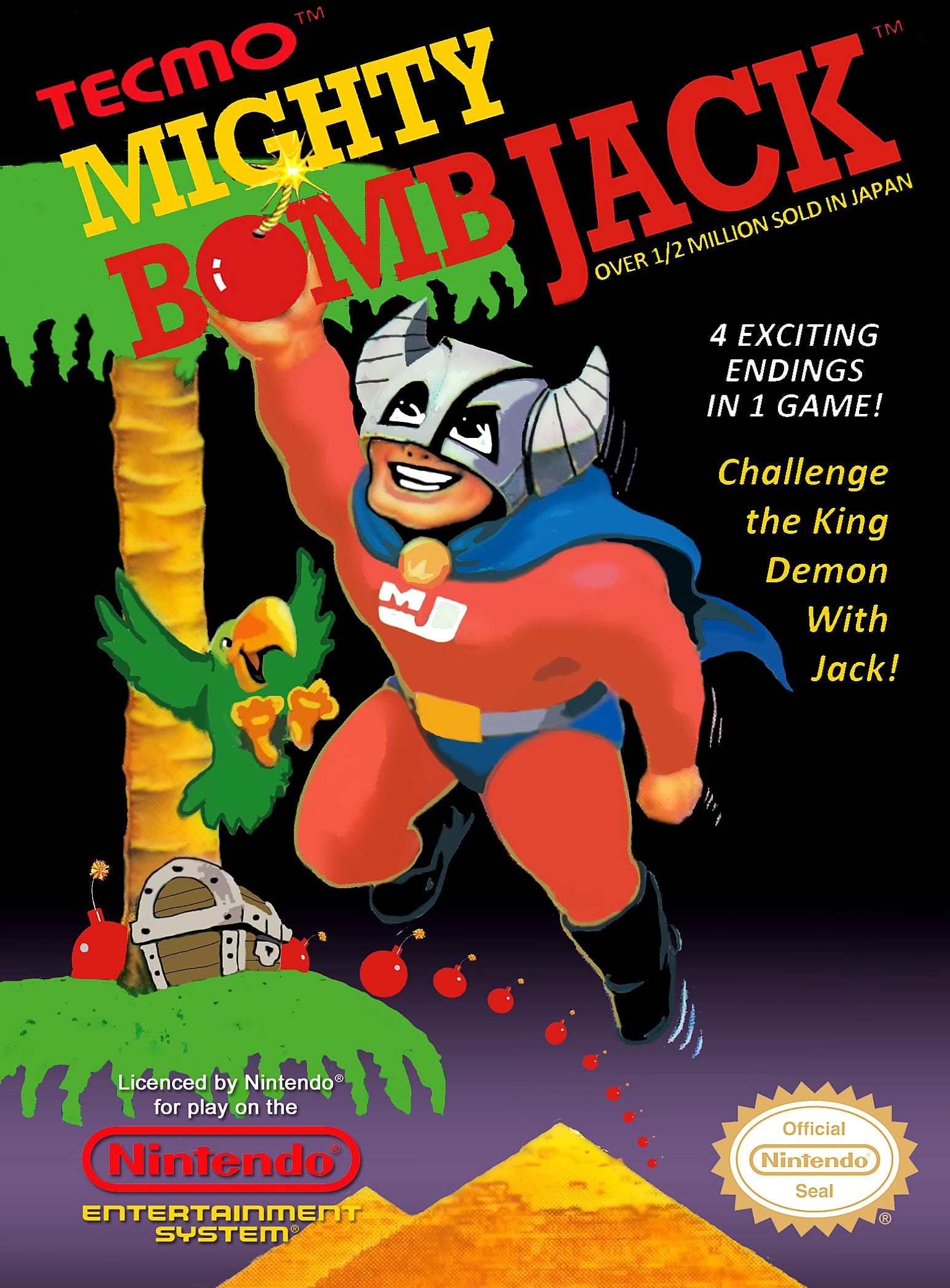
Mighty Bomb Jack
PUBLISHER/DEVELOPER: Tecmo
RELEASE DATE: April 24th, 1986 (JP), July 1987 (US), June 6th, 1992 (EU)
ALSO AVAILABLE ON: Arcade, Amiga, Commodore 64, PC, Atari ST, Virtual Console (Wii, 3DS, Wii U), Nintendo Switch Online
Mighty Bomb Jack is that special kind of NES game, a devious action platformer that plays by its own irritating rules.
You control Jack, a hero charged with rescuing King Pamera from the demon, Bezelbut. Jack’s not like other heroes, though. He has no direct attack to combat Bezelbut’s army of ghouls. Instead, Jack jumps, drifts, and floats his way out of danger. A hero without a weapon, a conscientious objector even in the face of pure evil. Not sure where the “Mighty” comes into his name, but there you have it.
Jack’s stuck in a pyramid, sixteen levels worth. Each level contains a side-scrolling passageway, littered with bombs, treasure chests and enemies, and a single-screen Palace Room, where you must collect all the bombs to move to the next stage. Bombs give you points and are easily collected, while treasure chests uncover helpful items, but can only be opened when Jack uses Mighty Coins.
The pyramid’s filled with all manner of secrets, good and bad. Hidden passageways can move you forward faster, but get too many Mighty Coins or Mighty Drink and you’ll be sent to the Torture Room, where your only means of escape is jumping fifty times. Multiple endings await you based on your skill level, but whether they’re worth the effort is another matter entirely.
Doesn’t take long for Mighty Bomb Jack to spiral out of control. Initially, the enemies go easy on Jack, like they know he doesn’t have any powers, he’s just pretending. Around level four, however, Bezelbut gets upset. The number of Mighty Coins dries up so Jack can’t open treasure chests. Enemies block your way forward, so Jack must hover over them to pass. Eventually, Jack loses all his lives and is forced back to the pyramid’s entrance. Nothing mighty about that.
Straight From the Arcade
Mighty Bomb Jack was part of Nintendo’s VS System arcade lineup, but only in Japan. The game was never released in arcade form in the US, Europe or anywhere else.
Alas, I couldn’t find an image of a specific VS. Mighty Bomb Jack arcade cabinet.
According to Mighty Bomb Jack’s Wikipedia page, the only differences between the Famicom/NES port and the VS. arcade version are a two-player mode, different location for certain secret passages, and “removing a warp in the Royal Palace rooms.”
*images from GameFAQs, Launchbox Games Database
Other Versions
AMIGA
ATARI ST
DOS
*images courtesy of Moby Games
Rygar
PUBLISHER/DEVELOPER: Tecmo
RELEASE DATE: April 17th, 1987 (JP), July 1987 (US), March 30th, 1990 (EU)
ALSO AVAILABLE ON: Arcade, Commodore 64, Amstrad CPC, Atari Lynx, Mobile, Switch (via Arcade Archives), PlayStation 4 (via Arcade Archives), Master System, Sharp X68000, ZX81/Spectrum, Nintendo Switch Online
Rygar’s a man’s man. He’s beefed to the nines, muscles on muscles, filled with stamina, vigor, and determination. His weapon is a Diskarmor, a shield with a chain that returns to him when he pulls on it. He was dead once, but now he’s back to slay evil again, restore peace to the land of Argool. Is Argool Rygar’s home? Does it matter? The man willingly came back from the dead, against all odds. His motives might be his own, but as long as he’s on your side, all is well.
Argool is a world of gods, ascetics, and supernatural creatures. Prophecies, salvation, and eternal goodness come against the usual cadre of evil, demonic influence. Rygar’s a strong warrior, but he needs help, just like the rest of us. The Indora gods, the ones who sit atop pillars of stone and pray for the world, assist Rygar with knowledge, health replenishment, and the occasional item to assist in his quest.
These items are critical. Rygar’s Diskarmor is a loyal friend, but he can’t move forward without the grappling hook, the wind pulley, or the crossbow. If he collects enough Mind Points, he can boost his strength, lengthen his grappling hook, or refill his health. The more enemies he fights, the stronger he becomes, the more life he acquires. Leveling up and grinding were novel, forward-thinking mechanics for an action platformer in 1987, but Rygar doesn’t know about any of that. He’s doing what’s required of him, and it feels right.
Argool’s not the prettiest world to rescue. Lots of monotonous hillsides, mountains, and large trees, full of cursed creatures that had no business being born. Sometimes, though, you gotta fight for what’s in front of you, not for Paradise. Rygar understands that. That’s why he’s a hero.
Straight From the Arcade
It should be noted that most every version of Rygar, including the original arcade version, is different from the NES version; so much so that some websites, like GameFAQs and Moby Games, organize the two separately from the other.
The arcade version and many of its ports are a more straightforward brawling experience compared to the non-linear, RPG-lite NES version.
*images courtesy of EscapePod Online, Flickr, the Arcade Flyer Archive and Moby Games
Other Versions
AMSTRAD CPC
LYNX
MASTER SYSTEM
ZX SPECTRUM
*all images courtesy of MobyGames


Collecting bombs but not blowing them up? That sounds weird…