
Popeye Teaches English to Japanese Kids, + Table Games Really Bring in the Adults
Famicom Friday Issue #001
Welcome to the inaugural issue of Famicom Friday!
I know I said I wasn’t going to be playing any Japan-only Famicom games alongside the US-released NES games, but I changed my mind. Not sure how often I’ll feel like covering really obscure Famicom games, but for now, I’m quite into it!
Whenever I do release a Famicom Friday, however, much like the main quest, I’ll be proceeding through the Famicom library in chronological order, starting with Gomoku Narabe Renju (just rolls off the tongue).
Why am I starting with Gomoku… and not the original Famicom launch game trio of Donkey Kong, Donkey Kong Jr., and Popeye, you ask?
Well, if a game released in the US at all (even if it was released in Japan first), then it will be covered in the main Nintendo is Great posts, according to its US release date.
If a game only came out in Japan, it will be featured in Famicom Friday, according to its Japanese release date.
I hope that makes all the sense to you. If not, leave me a comment, direct message, you know the drill.
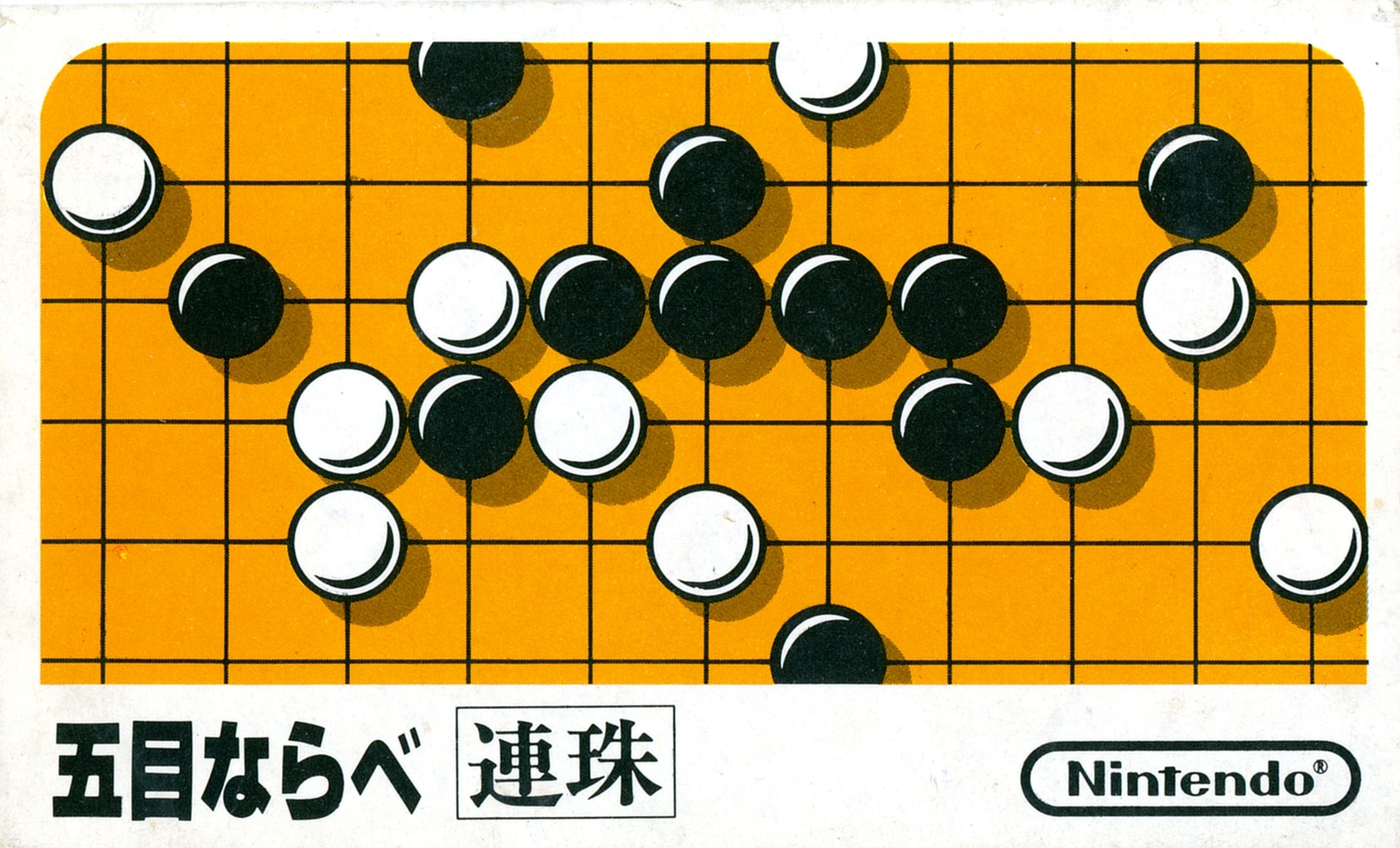
Gomoku Narabe Renju
PUBLISHER/DEVELOPER: Nintendo
RELEASE DATE: Aug. 27, 1983 (JP)
Donkey Kong, Donkey Kong Jr, and Popeye were the only Famicom games on the market for a solid month between July and August of 1983. Sure, two of those games are top-notch arcade ports, and I’m sure the lack of other titles boosted their sales, but… nothing else, Nintendo? Surely the parents who just spent ¥14,800 on a brand new Famicom would appreciate more adult fare?
Contemplate and you shall receive. The next two Famicom titles released were Gomoku Narabe Renju and Mahjong, two games geared towards an older demographic. Gomoku Narabe – known as Five in a Row – is a simple title where you connect five black or white dots together in a vertical, horizontal or diagonal row. The phrase “renju,” according to Romhacking.net, “refers to the professional rules that make the game more difficult for the black player (who always goes first) thus making the chance of victory more even for both players.” Alrighty then.
Basically, you connect your own tiles, you block your opponent’s connection, they block yours, the dance continues until one of you wins. Imagine Othello without the added layer of strategy (no flipping over your opponent’s tiles, just connecting), and that’s about it. Depending on your fondness for connecting things, Gomoku Narabe Renju is fun for ten minutes or ten hours. The game isn’t a terribly deep experience, but it is better than Popeye.
C
Mahjong
PUBLISHER/DEVELOPER: Nintendo
RELEASE DATE: Aug. 27, 1983 (JP)
Mahjong is what you might expect, simple two-player riichi mahjong between you and the computer and the first in a sea of Famicom mahjong titles.
Do you know how to play mahjong? Then Mahjong will likely be a slow-paced experience, especially if you’re used to playing online, or against two to three other people in real life. Don’t expect to modify rules or find any options here. You can’t even compete against a friend. You challenge the computer in easy, normal, and hard difficulty modes, and that’s it.
Do I know how to play mahjong? Sort of. I’ve learned the basics for the sake of reviewing SG-1000 mahjong titles, but not long after I learn, I forget. Perhaps it’s because I don’t play regularly, but that seems unlikely. I like the idea of mahjong, I rarely forget the rules of games I enjoy playing, and the core experience doesn’t seem that complex. For whatever reason, mahjong just never seems to stick.
Even though I can’t play very well, Mahjong still strikes me as a serviceable, if antiquated experience. Fine for 1983, unreasonably quaint for today.
1983: B, if you love mahjong
Today: D+, even if you love mahjong.
Popeye no Eigo Asobi
PUBLISHER/DEVELOPER: Nintendo
RELEASE DATE: Nov. 22, 1983 (JP)
Popeye’s comprehension of the English language has always been spotty at best. But I’ll be darned if Nintendo thought the oft-incomprehensible sailor was qualified to teach English to the children of Japan.
Popeye no Eigo Asobi (or “Popeye’s English Game”) is an absolutely adequate English lesson. As Popeye, you choose from one of six categories – Animals, Sports, Food, etc. Olive Oyl tosses hearts which form a word in katakana that Popeye then has to spell out in English. All 26 letters of the English alphabet* are at Popeye’s disposal, and naturally, he doesn’t just pick a letter – he uppercuts it, presumably with the power of spinach.
Spell ten words correctly and you’re rewarded with more words to spell in a different category. Pick an incorrect letter for the word and Bluto punches Baby Huey, like a true psychopath. If you grow weary of the one-player English lesson, there’s also a two-player portion where Popeye (Player 1) and Bluto (Player 2) try to see who can catch the most letters from Olive Oyl and spell simple words like “Bell” and “Cat.”
Popeye no Eigo Asobi is great if you need to brush up on your katakana or you’re a five-year-old Japanese child learning English in 1983. If you don’t fall into either of these two categories, the game is still better than Donkey Kong Jr. Math or even, yes, the original Popeye.
1983: B
Today: C-, for those who need it.


It’s rather enlightening to look at the early Famicom titles, there was such variety in them. Everything from arcade action to edutainment. Nintendo was really leaning into the Famicom being an accessible computer for the whole family, more so than just another games console.
This is awesome. Hadn't heard of any of these before.
On "Renju" -- it's fascinating that in Japan, a rule exists in a traditional game to eliminate one side's advantage. Chess really ought to have this. Give the black player the option to switch sides immediately after white's first move.
Mahjong -- I learned this game for the purposes of the minigame in Yakuza, and unlike, say, shogi , I think Mahjong is fundamentally bad and I don't understand how it ever became popular. In particular, most of its complexity doesn't seem to be in service of making the game more fun in any way. Are there really people in the world who have the scoring system memorized? It would be like if in Poker, instead of the ranking of winning hands being something that fits on an index card, it was a 20-page manual with all sorts of baffling edge cases. Jacks are worth more than Queens if the opponent to your right has a prime number of black cards, etc.
Popeye -- Fascinating that this exists, but only thing I'll say is that you've underrated the original NES Popeye! Maybe I'm biased because it was, I think, my 3rd game for the NES after SMB and Duck Hunt. Bluto was truly terrifying to a 5-year-old, but I think it remains simple but highly playable. B- at worst.