
Nintendo is Great is a Substack devoted to playing and exploring every game ever released for a Nintendo console/handheld in chronological order. Some posts are for free, some (like this one) are for paid subscribers only. Don’t forget to sign up below. Thanks for reading!
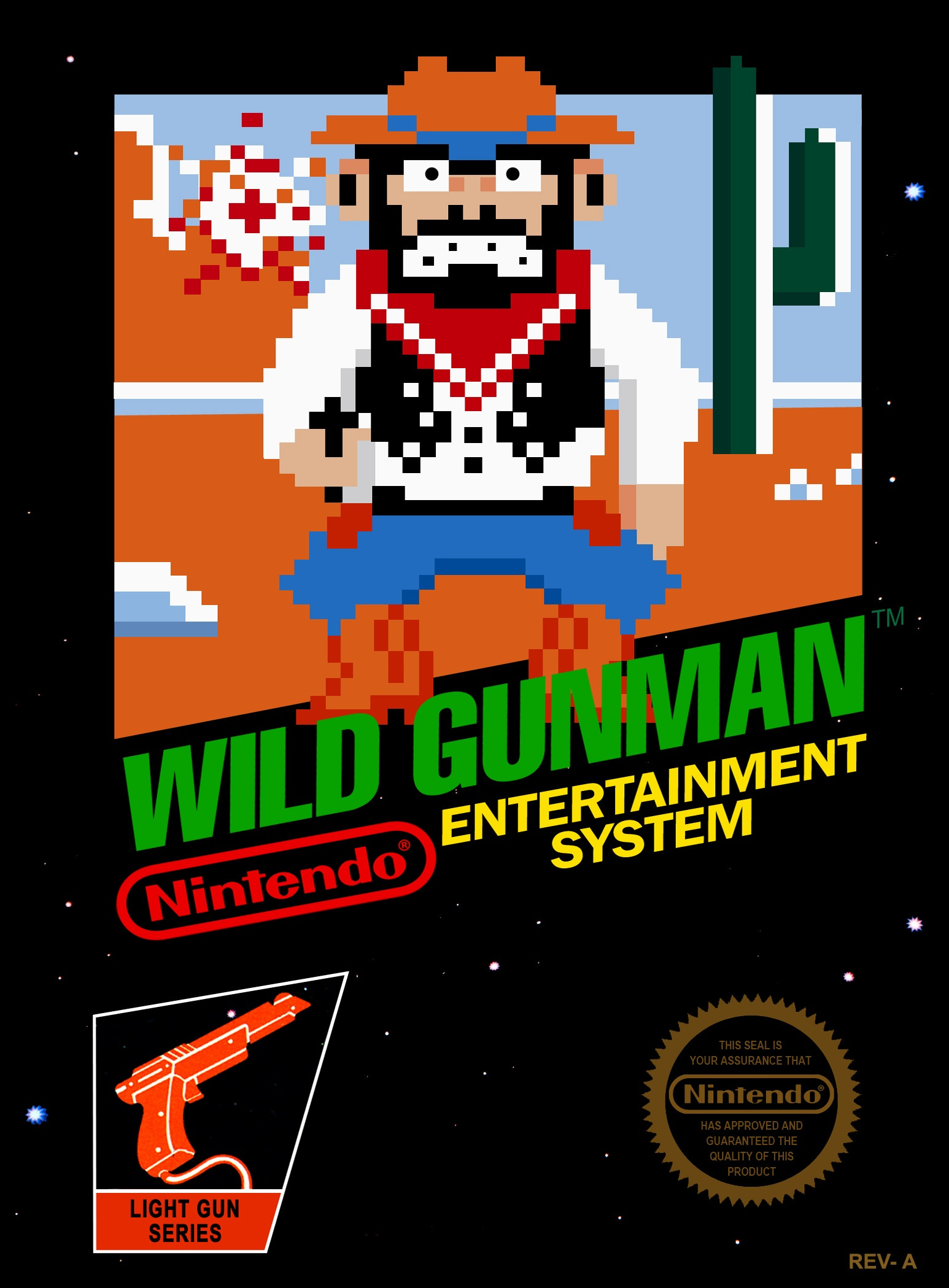
Wild Gunman
PUBLISHER/DEVELOPER: Nintendo
RELEASE DATE: Feb. 18th, 1984 (JP), Oct. 1985 (US), Feb. 15th, 1988 (EU)
ALSO AVAILABLE ON: Arcade, Wii U Virtual Console
Today, when retro enthusiasts think of Wild Gunman, they either remember grimacing cowboys losing their hat/trousers/dignity after being shot or that scene in "Back to the Future Part II" where Marty McFly destroys the arcade version. Wild Gunman itself? Not particularly memorable, unless you have a penchant for old light gun games.
Nintendo must have really liked the concept of Old West duels, though. The Wild Gunman we all remember was actually Nintendo's second go at a Wild Gunman game. The first, also titled Wild Gunman, was an electro-mechanical lightgun arcade game and released in 1974 in Japan (1976 in the US). This absolutely massive cabinet used 16mm film projection to display full-motion-video of an outlaw cowboy, ready to fire at you. When the cowboy's eyes flash, you draw and shoot. If you hit him, he'll fall over and the game will move to the next outlaw. Fail to shoot first and the cowboy wins.
I'm not particularly well-versed in arcade history, but prior to writing this article, I wasn't aware that any full-motion-video was used in arcade games, pre-1980s. I did a little digging, and it appears that Nintendo was the only developer using film-projection for full-motion-video in the 1970s. If this is truly the case (the Internet is often wrong, don'tcha know), imagine seeing Wild Gunman for the first time in arcades in 1976. Jaws dropped! Minds blown! Cowboy corpses everywhere!
Or... maybe not. If Wild Gunman (1974) was so technically groundbreaking, why doesn't anyone discuss or acknowledge its achievements in retro gaming circles? Perhaps very few have played it. I mean, look at that arcade cabinet. No way that thing cost less than five figures – in today's money certainly, if not 1970s dollars. Its' stateswide reach may have been limited to larger cities. Or perhaps Nintendo's cartoonish "revamping" of the Wild Gunman concept in 1984 became much more popular and widespread than the original? I have no answers. Given the fond memories many have towards crappy FMV games like Night Trap, lack of regard for one of the genre's originators seems more than a little strange.
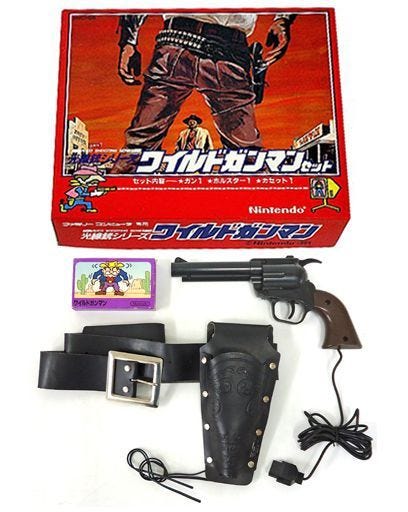
The Wild Gunman we’re all familiar with was the first light gun game for the Famicom a.k.a. the Japanese NES. As such, the game was packaged, not with the Zapper, but with the Beam Gun, a six-shooter/revolver that came with its own holster. If I had a sweet holster for my Zapper, perhaps I would have played a few more rounds of Wild Gunman as a kid, am I right?! Flimsy holster and plastic casing aside, the Beam Gun looks tremendously realistic. Even in the "it's ok for kids to play with fake guns" 1980s, I'm not sure America would have been ok with that.
With full-motion-video displaying real actors playing outlaw cowboys, the original Wild Gunman strove for pseudo-realism. Wild Gunman (1984) throws all that realistic trash out the window. Here, the five cowboy sprites immaculately crafted cartoon characters.
You could make up backstories for these characters based on their appearances alone. In fact, let's do that.

The Nameless Ones. The scraggly one – hunched over, unshaven – hasn't seen a person in weeks, and he's none too happy to see you. He's desperate which makes him more dangerous. The quiet one keeps his hat tucked over most of his face. It's hard to see his pupils, but if you do catch them, they have a soulless glint; like him and the devil worked out an agreement long ago. The nervous one's only fired a gun a couple of times. He's unsure of himself, but he's also squirrely. When shot at, he loses his pants. For him, embarrassment is worse than death. The fat one's draped in a sombrero and pancho. What does he have under there? He's a wild card. You know he's carrying pain, you're just not sure how intense. Then there's the boss. He's tall, well-dressed. He's got money, but how much remains uncertain. He's disinterested in your presence, but you're still a threat so he's come to take you out. Shoot him, and he'll lose his hat, revealing his bald head – a secret he wanted to remain hidden.
Alas, the sprites (and my unofficial biographies) are Wild Gunman's best features. This is one repetitive, monotonous shooting game that only ends when you run out of lives or just grow tired of shooting the same five cowboys. The latter probably won't take long.
Wild Gunman provides three options, “One Outlaw,” “Two Outlaws,” and “Gang.” One Outlaw has you shooting – wait for it – one outlaw at a time. Here, a single cowboy saunters out and attempts to intimidate you. Once their eyes shine and the announcer yells "Fire!" you have a limited amount of time (as displayed on the screen next to "Gunman") to shoot them. Shoot before the gunman shoots and you win. Shoot before the announcer yells "Fire!,” you get a foul and lose a life.
Two Outlaws adds an additional gunman on screen at the same time. Most of the time, both gunmen will yell "Fire!" at the same time, although occasionally only one will yell it. If you shoot both gunmen when only one yells "Fire!", you will lose a life and be sent to jail for murder.
Gang places you in front of a saloon with several windows. Once the round starts, the same cowboys (up to their no good tricks) from the Outlaw portions of the game pop out of each window, begging to be shot yet again. Shoot them all with your limited bullets, survive the wave and your reward from the sheriff is doing it again.. and again... and again.
Are we noticing a pattern here? Wild Gunman asks you to shoot the same five men over and over in different placements and venues, until your trigger finger can't abide any more abuse. Perhaps we enjoyed such mind-numbing exercise in 1985, but now? It doesn't help that Wild Gunman's hitbox is generous to a fault. In the Outlaw areas, you can just fire near the gunmen and they'll be shot. This makes two of the three options far easier than they should be. Gang is slightly harder, due to the smaller hitboxes, but shooting outside the saloon still grows wearisome far too quickly. There's a snake in my boots, indeed.
C-
What I Wrote About Wild Gunman in 2014
“Like the other Zapper launch games (Duck Hunt and Hogan’s Alley) Wild Gunmen is quick arcade entertainment designed to show off the gun’s features. You won’t find depth here, but as a brief pick-up-and-play, it does the trick.”
B-
Wrecking Crew
PUBLISHER/DEVELOPER: Nintendo
RELEASE DATE: June 18th, 1985 (JP), October 1985 (US), Oct. 15th, 1987 (EU)
ALSO AVAILABLE ON: Arcade, Famicom Disk System, Gamecube (via Animal Crossing), eReader, Game Boy Advance, Virtual Console (Wii, 3DS, Wii U), Switch (via Arcade Archives), Nintendo Switch Online
Before Mario fully gave himself to the plumbing/princess saving professions, he moonlighted as a tennis referee in Tennis, a retired golfer in Golf, and in Wrecking Crew, a fantastic construction worker. Or, perhaps, a “de-struction” worker. Everything Mario touches with his mighty hammer – doors, ladders, brick walls, etc. – is laid to waste before he’s off to the next construction site. Mario’s so good at his new job, in fact, that the foreman Spike fears Mario will soon supplant him. Spike, along with his band of sentient wrenches and anthropomorphic eggplants, are trying to fire Mario permanently - if they can catch him first.
To survive beyond the first few jobs, Wrecking Crew requires brains as well as brawn. Doors and ladders haphazardly placed in awkward locations, so you have to climb up, down, around, then back up again just to take out one brick wall. Mario’s tenacious, so he doesn’t care much, but he still needs to watch his step. If he accidentally destroys the wrong ladder, he could be hindered from climbing up to take care of any remaining structures, which means the whole job must be started anew. In addition to his terrorizing co-workers, bombs are also in Mario’s path. Neither friend nor foe, these explosives can be used to destroy a row of doors or cripple a row of brick walls. Bombs also always knock Mario down to the ground, which can be dangerous depending on who’s down there.
The further Mario ventures into the construction world, the more insane it becomes. The wrench and eggplant goons are everywhere, while Spike’s always watching from behind the scenes, trying to prematurely destroy any structure before Mario can finish the job. Luigi can help, if need be, but even with his assistance, Mario should ask himself if this job is worth all the trouble.
B+
What I Wrote About Wrecking Crew in 2014
“Wrecking Crew is the unsung gem in the NES launch library. Other launch titles like Donkey Kong Jr. Math or Urban Champion felt dated (and awful) from the moment you played them, but Wrecking Crew remains addictive and enjoyable to this day. For my money, it’s one of the quintessential puzzle titles for the system alongside the Lolo series. The game would also be Mario and Luigi’s last blue-collar excursion for years. Mere months after Wrecking Crew, the brothers were promoted to the high-wage, high-risk position of “Princess Rescuers,” inherited the lofty “Super” moniker, and the gaming world was never the same again.”
A-


Great history lesson on Wild Gunman. I really don't know much about electro-mechanical games. Especially these more advanced ones. Does whack-a-mole count? I wonder if these kinds of games were much bigger in Japan than the US, or if video games simply displaced them so fast that we have no cultural memory of them.
I've unfortunately never had the chance to play the NES game -- not an easy one to play on emulation, and I never encountered the cartridge back in the day. But that revolver with the Famicom version is wild. Already by the 80s, I think American toy guns nearly all had that orange plastic on the muzzle, though IIRC I had a pair of shiny metal cowboy revolvers that did not.
Back to the EM version of the game: in TV shows, I've seen references to old (1960s-80s era) driver's ed simulators that combine a projector film with some sort of steering wheel input. I wonder if that tech is somehow related. Here's what I could find on YouTube:
https://youtu.be/pLL06pG4L_U?si=-Whfh-K1-RuAuiD9
In that case, it looks like the film doesn't respond in any way to the inputs, but a mainframe computer takes your inputs and grades them. I could be wrong but thought some of these systems, maybe later versions of them, could respond a little bit to input: offering an appearance of drifting left or right within the lane or speeding up or slowing down.
Later on there were VHS games like Captain Power. I had this toy (and accompanying tape):
https://youtu.be/13oBNVdtJR8?si=gRPPx9euL6KPOYTV
Of course while the toy gave you a score, that VHS didn't respond in any way to inputs, but at age 5 I was semi-convinced it did.
As for Wrecking Crew -- a game that I sense has a lot going for it, but all the times I've sat down with it, I haven't been able to get into it. I also haven't been able to get into Wrecking Crew 98, and I'm curious if it's seen as the better or worse game.